Written by Nantarat Pam
Two angels over the sky of Berlin. That was how it started. And from that, Wim Wenders created a poetic, experimental, transcendental film that captures a city at a moment in time, celebrates the joy of human life, and lingers in one’s mind long after it is over.
Returning to Germany after a long time in America, Wenders wanted to capture the divided post-war Berlin. He wanted to make a film where this “very peculiar island of a city” could “really show itself in all its facets.” He wanted to capture the Berlin of 1987, this peculiar moment in time, and to capture its history and memory. At the same time, he also wanted to capture the Berlin of his youth – and the one in his heart; “whatever connected me to the language, to the place, and to the history.”
Inspired by reading the poetry of Rainer Maria Rilke – Wenders started to see the imagery of angels on top of buildings, and strolling the city. Angels, after all, can be anywhere and tell the story of everyone. They can cross any borders; be omnipresent. They could allow the complete overview of the city in all its history, heart, and facets that Wenders wanted.

So, we have angels.
Angels who have no halos, and don’t show us their wings. Angels who wear their hairs in neat little ponytails, and don on long, winter coats with scarfs. Angels who stand on tops of impossibly tall buildings, looking pensively at the city below. Angels who hover, as the film camera does, over all the houses and streets of Berlin. Angels who also stroll amongst us. Angels whose duty it is to observe; to hear our inner thoughts and watch our action.
They lend their head close, and listen to those endless streams of consciousness in our head. They listen; patiently, endlessly. They lend their hands to our shoulders – a gentle touch; to influence our thoughts with their light – however little that light may shine through in these dark times. To soothe the hopeless, the suffering, the dying.
Angels who, always, gaze at us with love.

Sometimes, they report to each other; before time, there were us. Before humanity, there was a river. Before airplanes, a Frenchman flew over the city in a hot air balloon. Fifty years ago, the Olympic game. Twenty years ago, a Soviet jet fighter crashed into the lake at Spandau. And today, a woman in the rain let herself get drenched. A schoolboy described to his teacher how ferns grow out of the earth. Life. Time. And angels – they watch, they listen, and they report.
So is the story of “Wings of Desire” (1987); at its core, one could say there is no story at all – not in the traditional sense, anyway. It is an exercise in observation that requires one to be as endlessly patient as the angels we watch. At the same time, it is all the stories; one of the city, its people, its history – one of space, time – pain, joy – eternity, humanity. And, in the second half, it is also a simple story of an angel who ‘fell’.
Wenders consulted with screenwriter and frequent collaborator Peter Handke to develop the concept of his film. Hendke, understanding that Wenders wanted to create an atmosphere, came up with philosophical pondering monologues rather than a traditional script. The angels, as ever, allowed the two to mostly incorporate their fragments of ideas. Handke also thought, as many of us might, that if he was an angel – he would like to become a human. Thus, that is where the story goes; the story of an angel who wants to become a human.

One of the angels, Damiel (Bruno Ganz), expressed a desire to become human; to, instead of always hovering above, have a weight grow in him and tie him to earth. To be able to walk, to take in each gust of wind. To sit at a table and be greeted, even if just by a nod. To come home after a long day at work and feed a cat. To have fevers. To have blackened fingers from reading the newspaper. To be excited, at last, by a meal. To lie. To have the joy of guessing and not always knowing. To be able to say “Now;” now and here, instead of “forever” and ‘for eternity.” To be able to say “ah” and “oh” and “hey” – instead of “yes” and “amen.”

Damiel became fascinated by a lonely trapeze artist, Marion (Solveig Dommartin). And one day, through some miracle, his wish came true. He became human. He searched for Marion, and they got their happily ever after.
That is, in the traditional sense, all the story of what Wings of Desire is. Yet, I almost felt the need to not write all of that at all. It feels like such a disservice to the film to attempt to describe it in words, or put it into a narrative. Just as it always feels like an injustice to describe a poem or a song – the film is, to me, an experience. One can get infinite impressions on it, and that is the beauty of this cinematic poem.

I believe that the atmosphere it creates is more important than describing the details of what happened or trying to interpret what it all means. As Roger Ebert, an infinitely better writer than I can ever hope to be, put it; “The film evokes a mood of reverie, elegy and meditation.”
To me, the cinematography alone is worth watching once in a lifetime. I will admit that it is a sluggish, leisurely stroll that is endlessly pensive; do not take lightly my warning that it is a slow film. Do not expect dramatic tension, the rush of a plot, or a satisfactory story. As Ebert wrote; “‘Wings of Desire’ doesn’t release its tension in a smooth plot payoff. It creates a mood of sadness and isolation, of yearning, of the transience of earthly things. If the human being is the only animal that knows it lives in time, the movie is about that knowledge.”

Watching it during a depressive episode, I won’t lie that I was completely engaged with it at every moment. To tell you the truth, there were moments where I fast forwarded, or wanted to turn it off completely. Yet, it lingers in my mind. I came back to it, and as I think about it, I noticed the beauty of it more and more.
I suspect that, had I seen it on the big screen in a dark room, my experience might have been downright spiritual; so, if you have the chance, I implore you to do so. To be forced to sit with it is perhaps the best way to experience the film; like a meditation, once the body and mind adjusted to the heartbeat of the film, a special reverie is evoked. It is melancholic, but never depressive. Pensive, but also never pretentiously serious.
The film essentially gives you wings and takes your hand out on a flight; descending onto houses, strolling along the streets, taking a break on top of statues, visiting the library and the circus – all the while listening to people’s thoughts. Being an angel for two hours was a surreal, meditative and unforgettable experience.

On my second viewing, I began to construct my own interpretation of the film and thus enjoyed it a lot more. This is certainly a film I recommend analysing and going back to; it states very little clearly, so interpret as you wish and have fun with that. Think of the acting, the framing, the editing – and at the themes we will discuss. I think it is one of those films that can both be enjoyed as a pure experience and can be fun to make your own intellectual pathway through it.
To me, it is truly a poem in that it can be infinitely interpreted, but most of all is meant to be a slow wave that washed over and submerged you. While the film can certainly be intellectualised and analysed through academic lenses, and trust me, many have done so in ways I will admit I don’t fully understand after reading them – it is in the end not what the film is for me.

For me, one can analyse it to an extent – but one should also keep in mind that it is a film shot day by day without a script, where each actor contributed heavily to the story. It is an experimental project for Wenders that was equally an exercise in creating an atmosphere, creating beautiful imagery, creating a memory time capsule, and having creative fun with his friends. The behind-the-scenes documentary and outtakes particularly influenced this opinion for me.
But, as I said, I think the fun of the film – and cinema in general – is the endless amount of interpretation a piece of art can have.
The rest of this piece, therefore, will be my personal musing on the film – told, true to the style of the film, in fragmented streams of consciousness.
Take it as entering a dream with the angels and hover over the Berlin of this beautiful movie, as we ponder over history, meanings, humanity, Good Omens, and my love for Peter Falk.
I
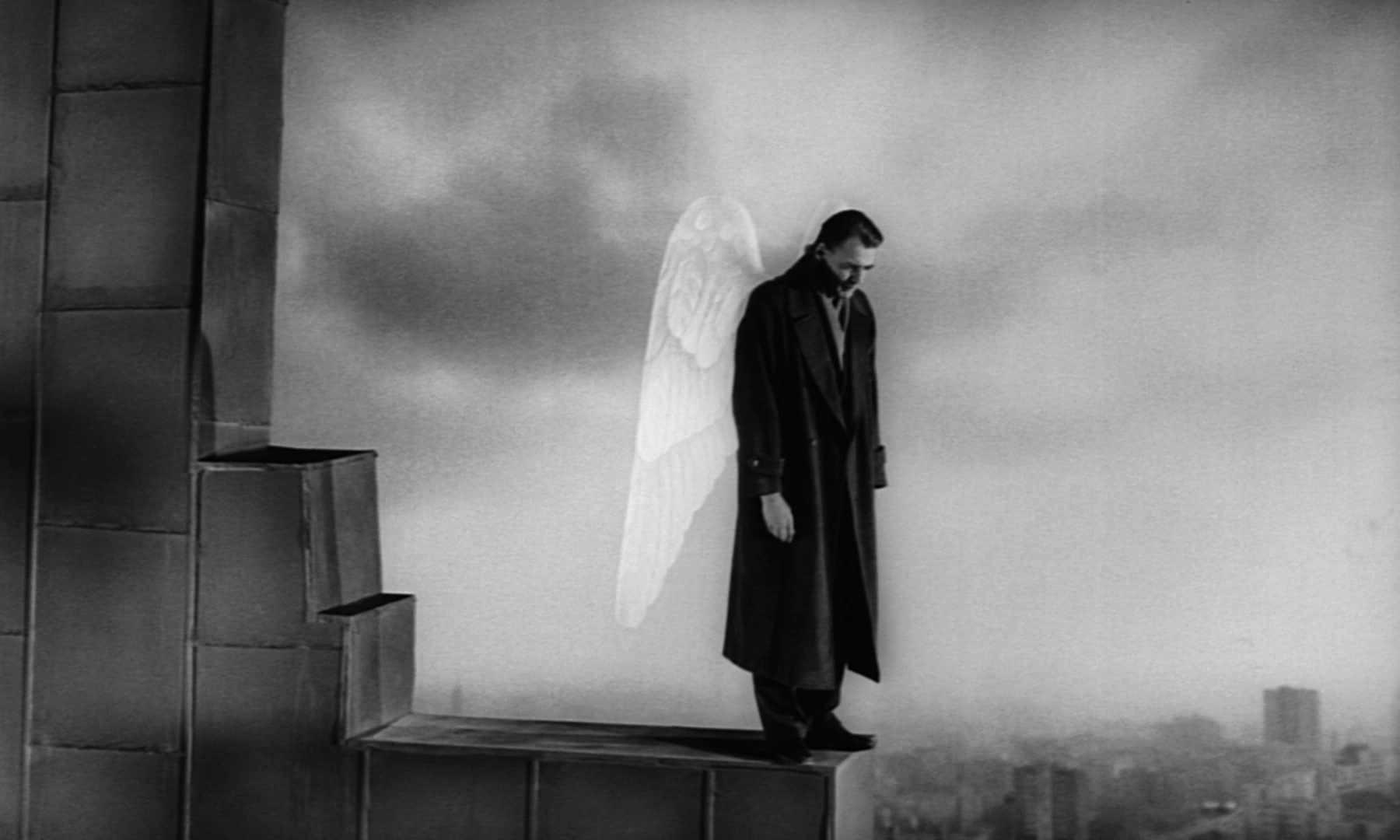
In black and white, a man stands atop a famous symbol of war-torn Berlin, the broken steeple of Gedächtniskirche. Behind him, white translucent wings shine. His face is not that of a chiselled Greek statue; he looks human, as far as the eye can see. He looks upon the city below with a pensive gaze. As we will come to see – this is the face of an angel. Forever looking pensively at a world they are forever detached from; a world they can only watch in black and white. But Damiel does not only look from a distance with detached gaze; like all the other angels, he has seen humanity since its birth. Like the other angels, he gazes at humanity with love.

But Damiel’s gaze reveals something else; curiosity. He is, as the children he adores are, endlessly fascinated by the smallest details in the world. Humanity amuses him; he loves to observe them. More than that – he yearns for it. To be part of it.
Those are all embedded in the performance of the great Bruno Ganz. The iconic imagery of the angel above Berlin arguably defines the essence of the film – and I believe that his gaze alone holds a world of emotions.

The gaze; that was what Wenders considered to be the most important thing. The angels have no biography for the actors to base their performances on; they have to childhood, no history, no relationship, no individuality. They didn’t have a script; no dialogue, no voice-over (which was written as fragments of ideas and to be recorded later). The actors had nothing to go off of but their own performance; they had to invent the characters.
The only thing Wenders knew about his angels – was that they love people. And that the love is expressed in their gaze. Wenders told them that a gaze, if you do it right, can do a lot. To me – Ganz achieved this phenomenally. Just from his face one can feel the love he has for humanity, his joy of watching humans, and his yearning to join them.

The other essence of the film, another of its most famous qualities, is its black and white cinematography. Shot by Henri Alekan – the cinematographer of 1946’s “Beauty and the Beast” and “Roman Holiday” (1953) – the black and white scenes represent how the angels see the world. In this monochromatic view, Wenders portrayed the detachment of angels and the melancholy of watching the world from eternity but not being able to participate in it and not being able to feel the sensual joy of being human. The cinematography almost captures the idea of pensiveness itself; pensiveness and nothing else. It puts us in the shoes of the angels on an emotional level; we immediately understand how Wenders’ angels view the world. Wenders also felt that, in black and white, one sees more of the essence of things – just as the angels see.

The scenes from the human perspectives, however, are shot in colour. Obviously, it portrays the way humans see life – literally in colour – and in essence portraying the liveliness, boldness, and colourfulness of human existence. For me, aside from the obvious symbolism, I like the idea that it is meant to jump the viewers into seeing life as a child would see it; being deprived of colours for so long – when the scenes from the human perspectives come, we find joy in seeing colour as if it is our first time. Because the film is primarily in black and white – the colour scenes are striking – which could also symbolise how Damiel sees human’s perspective; how exciting it is for him, how much more colourful it is than his angelic existence. The film reminds us what a wonderful thing it is to be alive by making the thing we take for granted, like seeing colour, magical once more.

Indeed, once Damiel becomes human, he finally sees the world in colour. One could read this ‘fall’ as being motivated by him falling in love with Marion, the beautiful trapeze artist – but I see it more in the tradition of Ariel. The love interest is only the trigger, but Damiel has always longed to be part of the world of humans. It is that intense longing that made him finally ‘fall’ in the end.

Marion, being a trapeze artist in a circus, could also symbolise the extreme of the human experience. The circus is sensual – loud, full of energy, filling all the senses. A trapeze artist also feels their weight completely – parallelling directly Damiel’s desire to feel the weight of his body. Marion also travels with the circus, which moves at all time, never staying or belonging anywhere; perhaps paralleling the transient nature of being human. The circus, her setting, contrasts her to the other seemingly unmovable buildings of Berlin. And even though Marion expresses loneliness, yearning, doubts and fear in her inner monologue – Damiel still fell in love with her. To Damiel, Marion is the essence of human life itself; she symbolises completely the extreme of human existence – and he is in love with all of it.

Indeed, one could see this second part of the film as the experimental monochromatic melancholic elegy becoming a lovely fairy tale fable. The main character sacrifices his immortality to become a real boy and gets the girl; it is a classic bedtime story. Marion even flies in the circus with angel’s wings on her back; she and Damiel almost seem destined to be together, like the characters in a classic romantic tale. In some lenses, it does not fit with the first part of the movie at all. Suddenly, there are colours, a simple story, and the film almost seems to become a sappy, corny romance with no more philosophical substance. I fall in the camp that thinks that switch is not an error, but rather is the point.
For me, the story was never meant to be bleak; the hopeful ending is in-keeping with the film’s celebration of human life. Even despite all the suffering we have seen throughout the film – it ends with a proof that love can exist. Even though it is heightened and idyllic, I think that may be Wenders’ way of sealing the point. After all, the film was supposed to end with a pie fight (which you can see in the outtakes). Even if the movie changed directions, I think it illustrates a point that the ending was always meant to be joyous.

On a more intellectual level, the film and the ending could be seen through the lens of dichotomy. An interesting interpretation is that the world the angels see, even though not ‘real’ (Damiel views it as pretence), feels more real to us in their realistic portrayal of human lives than when Damiel finally enters the human world – where the narrative becomes a Hollywood fairytale.
In David Harvey’s The Condition of Postmodernity, he argues for a different kind of dichotomy. Harvey argues that the majority of the film is postmodern – mirroring post-war Germany itself – while the second half attempts to reaffirm a form of modernist narrative of togetherness and hope. It could be read that the film brings together both the modern and the postmodern; a mythical or fable-like story emerging from the postmodern one. The ending thus could be seen as the film breaking from postmodernism to modernism – from fragmentation nonlinear experimental narrative to a very classical, hopeful one – while at the same time uniting the two in the same story.
This paradoxical breaking and uniting, again, goes back to the essence of post-war Germany; whether it be its literal division by the wall, its attempt to break away from its past yet having a reminder of it still very present – and perhaps having to embrace it to move on. Perhaps, in that way, Wenders is hopeful that togetherness can emerge from a fragmented past. That, though the history of his home is full of melancholy, alienation, and the city being broken into pieces – metaphorically and literally – the future can be a hopeful one, filled with or perhaps fuelled by love. The postmodern and modernism in the film, to me, represents the duality of Berlin, of history, and the duality that is ever-present in humanity in general; whether it be evil and goodness, suffering and happiness, or apathy and hope.

Berlin itself, in the film, is depicted in lights of dichotomy and duality. As Wenders aimed to do, the film captured a unique city that is divided in many ways. It belongs to the past – with rubbles and bombed buildings still a common sight – yet it is witnessing unprecedented changes and being dragged into an uncertain future. In the architecture of Berlin, a prominent aspect of this film, the old and the new coexist. Postmodern buildings stand alongside war-ravaged ones. Seeing those buildings together, the city feels almost unnatural and artificial. Like the angels, Berlin is stuck in a paradoxical limbo of time – belonging to a historied past but also witnessing the ever-changing world. The angelic hymn in the soundtrack also contrasts to the Nick Cave concerts presented in the second half of the film, representing the new alternative music scene in Berlin at the time (which Wenders was a huge fan of).
I am not a historian of post-war or Cold War Berlin, nor an art historian of architecture, so this aspect of the film is sadly not something I can explore in depth. Nevertheless, I think it is essential to get at the idea of what Wenders’ sat out to do; what it means to capture a picture of Berlin at that moment in time.

I believe that, to a more knowledgeable audience than me, the film does capture the nuances of what Berlin was at that time, why it was so unique, and the essence of the city – the buildings, the streets, the people – in just its cinematography alone. Watching Wenders The commentary on the film was illuminating, particularly in this aspect; every location depicted in the films has a story. It was like listening to my parents walk through our hometown and explaining the history of each lot, what used to be there before they built the mall, or what location was the landmark for the locals that they remember the city by.

Many locations in the film are there because Wenders likes it most; because, to him, they represent the essence of the city. With just the imagery, Wenders was able to capture Berlin; It is truly one of my favourite things about cinema – how something as simple as filming angels travelling to different locations can tell such a rich story just by the ways the locations are depicted alone.
The locations – the airplane, the houses, the library – can also be seen as a tribute to human creation and the knowledge we have gained since our birth as a species. But, as we discussed, the worst of humanity is also symbolised in the war-torn rubbles – reminding us of the atrocities we have also accumulated in our history. In this way, the film is truly a tribute to all that humanity is – both the good and the bad. Berlin, to Wenders, perhaps felt like a microcosm of the dichotomy of humanity.

Division, dichotomy, and opposites – as is arguably symbolised in the most famous feature of 1987 Berlin, the Wall – to me, is the thread that runs throughout the themes and aspects of the film. So, hang tight to it as we move on from atop the buildings to city…
Oh, before that, have I not forgotten something? 3,000 words ago – at the beginning – I have said this is a story of two angels, haven’t I?
II
If you know me at all, you know that one of my favourite shows of all time is “Good Omens” (2019). It features similar themes in general of eternal beings, in this case an angel and a demon, watching and admiring humanity and celebrating human life despite all the evils in the world. But the reason I want to bring it up here is, again, the idea of opposites. What makes Good Omens so compelling is that we see the perspective of Aziraphale, an angel who is nice, kind, and loves humanity – and Crowley, a demon who is moody, mean, but deep down loves humanity as well. Both of them, like Wenders’ angels, love humanity – but while Aziraphale views and interacts with humans with optimism, Crowley is more realistic in his pessimism.
I think opposites compels us; especially in a narrative like this, where it allows us to contrast two ways of viewing humanity. Which I think is why, in so many interpretations I have seen – Cassiel is seen as the opposite of Damiel.

Donning the same winter coat, scarf, and light hair tied into a small ponytail – an angel stands atop the enormous golden Winged Victory statue. Amongst the cloud, he looks upon the city below with weariness. He descends to the human world, to a car showroom. Here, he meets with his fellow angel Damiel, and they exchange the notes of human activity they have observed.
Being the other half of the lead in this film, Otto Sanders plays an angel named Cassiel.
Wenders knew that these two have been friends from the beginning of time, so he had to cast two really good friends. Luckily for him, Sanders and Ganz were good friends who had been in many projects together. I think that this was a crucial decision; casting two actors who already had natural chemistry together helped convey the angels’ friendship in a film where most characters only stare at each other, and rarely show anything with their body language. As Wenders had said, there is a lot that can be achieved with just a gaze.

However, Wenders noted, Sanders never got the hang of it. “He wanted his character to be meaner and not be the good guy all the time,” Wenders said. Ganz, on the other hand, enjoys being an angel and would still be if Wenders didn’t force him to fall.
Because the actors were so instrumental in creating their own character due to the film being shot day by day with no script – I believe that the actors’ intention and personality was very influential in the earlier draft of the film. From the outtake footages and Wenders’ interview, I get the impression that Cassiel was much more goofy, a bit mischievous, and playful. This would have contrasted Damiel’s pensive and more softly still attitude.

However, I think that in the final film Cassiel comes across as contrasting Damiel in a different way. He is more stoic, weary, and cynical; while Damiel always smiles at humans, Cassiel’s face shows nothing. Damiel appreciates little joy in human’s life – while Cassiel seems indifferent to it.
An interesting interpretation is that Damiel is drawn to happiness – while Cassiel seems drawn towards suffering. While Damiel prefers to watch over children and was transfixed by the circus – Cassiel traverses bombed buildings and thinks back to the war, seeing images of the destruction it caused. He is shown to follow worried and suffering people – most strikingly, a suicidal man. Amidst the emotionless face – then – one can see how he is haunted by these memories and what he has witnessed. An interpretation is perhaps this is why he is not sure if he wants to become human.

In the scene of him trying to comfort the suicidal man, I think, lays a key to where I differ from most interpretations of Cassiel. As Wenders has said – the only thing he knew for sure about his angels is that they love humans. I disagree with the interpretation that Cassiel does not care about humanity as much as Damiel does.

The decision to cast Bruno Ganz and Otto Sanders, I think, is brilliant on a visual level. Ganz has such a soft, kind face with doe-like brown eyes – contrasting to Sanders’ sharp edges and rectangular features with piercing blue eyes. Saders looks more like our traditional image of an angel, signalling that he is the one who would stick to such role. Their appearance alone tells us a difference in their character. Their demeanour reinforced this; one always smiling and enjoying human activities with child-like awe, while the other observed with detached melancholy or cynical amusement at most. At first this led to me thinking that with his kind face, Bruno Ganz would be the one that loves humanity and the other angel would be the cynical one that has seen all too much of men’s dark side. But I came away not thinking that is the case. Tare both very compassionate about humanity, despite having observed us for centuries and having seen everything we are.

I think the difference, like Good Omens, lies in their personality and the way they approach humanity – albeit in a less extreme manner. In keeping with the detached feeling of the film, both angels express very little; still, a difference does shine through. As I said, Damiel looks at humans with child-like curiosity and awe, smiling lovingly; Cassiel’s face almost always shows no emotions at all. That is, aside from the crucial scene I mentioned.


In it, Cassiel attempted to comfort a suicidal man; laying his face on the man shoulder, almost cradling him. The gesture of touching humans, for angels, means they are trying to lend their light to our thoughts; thus, here, Cassiel is trying his all to influence the man not to jump. He jumps anyway. And Cassiel let out a scream that still breaks my heart every time I watch it.

This scene breaks the still detachment the film has built up so far, jolting the audience. And it is the only scene where Cassiel, or indeed any character, shows extreme emotions. I think it illustrates how much Cassiel cares for humans.

After witnessing the suicide – near the end of the film, Cassiel stands atop the Victory Statue once more. He jumps. As an angel, of course, this does nothing to him. But it shows that he is haunted by the events he witnesses, and perhaps wants to understand the sufferings that he sees.
It is also interesting to note that (from my admittedly cursory research), in magical mythology – Cassiel is the Angel of Tears, of Temperance, and of Duality. Duality is, of course, a main theme for the film – as we discussed, and could point to his role as a foil to Damiel. Tears could also point to his attraction to suffering – and his own story being filled with suffering as well. Temperance points to his role as the observer of time, and his patient nature.

Mythical Cassiel is an angel withdrawn from humanity, embodying solitude; he observes, ever patient, but never intervenes. Wenders’ Cassiel seems to be heavily influenced by these lores – especially with how Cassiel’s story ends, as we shall see. However, being the angel of tears, he also comforts those going through great hardship – as we see Cassiel do with the suicidal man, even if unsuccessfully.


An interesting read is that Damiel is contrasted to Cassiel in how the former is child-like, while the latter is more like an adult; while Damiel is playful and sees the awe and wonder in everything, Cassiel is serious, dutiful and burdened by the past. As adults know all too well, the past wears you down. Damiel is paralleled to children, and thus always puts himself amongst them – or even with the child-like Marion.


In contrast, Cassiel is always hovering with the aged Homer. As Cassiel says, the angel has a duty to “do no more than look! Assemble, testify, preserve!”. As a dutiful angel, Cassiel is therefore paralleled with Homer in how they are burdened by the past, but also in their role as observers but not interveners – forever burned to only witness and not having the ability to change the outcome of the human race. Homer’s laments on humanity, such as peace not preserving, perhaps reflect Cassiel’s own thoughts. The library, Homer and Cassiel’s favourite place, is also parallel to them; it is a place built for assembling, preserving and testifying the past.


Cassiel’s proclamation to Damiel that angels must “Stay alone! Let things happen! Keep serious! … Do no more than look! Assemble, testify, preserve! Remain spirit! Keep your distance. Keep your word,” is very telling of his character and how different he is to Damiel. He acts in the ways he thinks angels are supposed to act; serious, strictly a detached observer, and a carrier of memories – preserving the past. The way Sanders delivers the line so uncharacteristically spiritedly perhaps also implies he might not want to play this role – but feels that he must do; almost as if he is reminding himself to stay focus on duty rather than be swept away by Damiel’s musing on how great being a human would feel.

Another interesting thing to note is the relationship between Cassiel and Damiel. They are friends, but their friendship shows little emotions or connection in comparison to most main friendships in a movie. Still, Damiel is almost the only character Cassiel smiles toward. When Damiel expresses the desire to become human, Cassiel entertains the thought, likely because he sees how enthusiastic his friend is about it – even though he is dismissive of the idea. And when his friend becomes human, Cassiel is still – in the end – supportive.
Note also that, while Damiel wants to “sit at an empty place at a card table and be greeted, even by a nod …coming home after a long day to feed the cat, like Philip Marlowe, to have a fever and blackened fingers from the newspaper, to be excited not only by the mind but, at last, by a meal … To lie! Through one’s teeth. As you’re walking, to feel your bones moving along,” – Cassiel replies “Yes, to be able, once in a while, to enthuse for evil. To draw all the demons of the earth from passers-by and to chase them out into the world. To be a savage!” Here again the difference between the two is shown; and I think it must be at least in part due to Sanders’ influence. He wants to make his character a bit mischievous.

The framing of the scene at the car showroom, with the two of them in the same frame together but then cut to them in separate frames when Damiel starts to talk about his desire to become human – reinforce the difference in their view about the idea. While Damiel is very enthusiastic about the idea of becoming human – Cassiel seems only to think of it at most as a thought exercise he is willing to indulge in because of how enthusiastic his friend is about it. As he tells Damiel later – it is something he thinks will never happen.
Cassiel, however, is arguably not shown to be wholly dismissive of the desire to become human deep down. By the end of the film, he seems conflicted. But to discuss the end of the film, there is someone else I need to talk about. So, for now, let us finally move from the angels to the humans …
III
Descending to the city below – where should we go? An impressive, beautiful building full of people comes to mind.


Wenders’ angels, uniquely from any other I have seen, lives in the Berlin State library.
Wenders said in an interview that “When we were looking for a place in the city where the angels would live, would be at home, we looked for some time. Since angels are not really linked between people and God any more, we could not do a church, so we tried for another place. Then I remember the ending of one of my favourite films, Truffaut’s “Fahrenheit 451” (1966), which is in this big open space, and there are all these people and everybody represents a book that they have learned by heart because books are persecuted and burned; and to me that was really a vision of paradise.” Wenders thought that a library is a “heavenly place,” and hat “there is a whole memory of mankind united there.”


We see in the library that there are many more angels than the two leads; all wearing coats, scarves, and having their hair in a ponytail. They all lean over to listen to the people working and reading.


This is also where we meet an old man (played by Curt Bois) credited as “Homer.” Yes, he is implied to be the ancient poet – in a magical-realism way. Many have analysed his role in the story, and I implore you to read the bibliography out. Cassiel seems to take special interest in the old storyteller; again, in keeping with the theme that he is attracted to the memory of the past. His loving gaze towards the old man also shows, to me, that he does appreciate humanity.
As Homer wanders to find an old building that is no longer there, Cassiel sees the flashes of war before him, symbolising how the scars of war are still fresh in the Berlin of that time. To me, Homer represents a bygone era; he personifies a past that is older than the war and division of modernity. As the poet laments, the time of people gathering around to listen to his story is gone. Homer ponders if he should give up now; he concludes that he can’t, or else mankind would lose its storyteller – which would mean losing its childhood. This could be interpreted literally – that mankind wouldn’t remember its origin without a storyteller to retell it – but also echoes the theme of child-like awe being the most important thing humans can have. Mankind cannot lose that, and must be reminded of it by someone. This, perhaps, could also be seen as Wenders’ own feeling towards his occupation and his feeling towards the mission of this film; to remind us to be in awe of life like a child.
I don’t have any deep analysis to provide here, but the idea that angels live in libraries is so precious to me. It filled me with such a fuzzy feeling; I love libraries, after all. I like to think that when I am there, I can hang out with all the angels.
Let’s stroll along to listen to the people.


An interpretation is that the uniting theme between all the characters is their feeling of isolation and alienation – a microcosm of the modern human condition. Most of the inner voices of the people the angels listen to are filled with worries, sadness, and a feeling that they are missing something in life. This extends to Damiel, perhaps himself feeling isolated and feeling that sense of yearning for something more to his existence as well. One could interpret a simple conclusion from the ending that what we are all missing is love; while that may be a part of it – I think the overarching theme of the film supports that what we are missing is perhaps more the love for life than any specific person loving us.
Disconnection and dissatisfaction, perhaps due to their inner focus, is seemingly shared between all in Berlin.
That is, of course, except Peter Falk.

I know that you have been waiting for this, so here it is. Let’s talk about Peter Falk.
Playing himself, the famous (to me) Columbo actor might seem like the most perplexing part of the film. He seems out of place; the very fact that he is playing himself is a comical departure that may take one out of the movie completely. He breaks the fourth wall of the film. However, as many have argued, I believe that is precisely the point. He is the comic relief, in a sense, that relieves us from the relentless pensiveness of the other characters. If you know Peter Falk, you can imagine the character; down-to-earth and playful – he exemplified the American attitude that contrasts sharply with the German melancholy of all the other humans.


That is, however, not only because he is American after all; as the story goes – we found out – he was a former angel who decided to become a human long before Damiel does. Before going into any sort of intellectual discussion, I must reiterate that, yes, Wim Wenders makes Columbo actor Peter Falk a former angel. That is insane. I love Wim Wenders for this alone. Anyhow.

Falk has a warmness to him – and in this cold and detached film it truly feels warm to be in his presence. There is a scene of him and Marion meeting at a coffee stall where she almost certainly seems to be breaking – and him improvising along with her. It brings me so much joy.
He is, arguably, the only character who is truly alive and in the present. He is, as a former angel, appreciative of all the little things in life. He walks around and appreciates the cities and its people – and you truly get the sense that he is happy, content, and enjoys the walk. In contrast to the detachment of the angels, he is always living in the moment and is fully part of the world.

Like the angels, he notes down humans in a little black notebook – only, for him, it is in the form of drawings (Peter Falk, of course, is an artist in real life). As an amateur artist myself, I can attest that to draw someone is to appreciate all their features. Falk is, as all angels do, in love with humanity in all its facets. He is not an overly happy character – but the word I would use to describe him is that he is content. I think contentment, even more than happiness, is the best we should strive for in living this life.


Peter Falk serves as our bridge back to the best side of humanity. After spending the first half hovering over the city in detached melancholy and listening to the worries and inner pains of humans – we are reintroduced back to the joy of being alive through the eyes of this former angel, who could look at the world through the same child-like awe that makes the smallest everyday things seems so wonderful.
Another thing to note, in favour of my interpretation that the film is not supposed to be taken too seriously at face value, is that Falk came up with all his inner monologue himself. I think the beauty of Wings of desire is in these imperfect improvisational qualities rather than it being a perfectly calculated piece of art where every aspect needs to have a higher meaning. Not that I think Falk’s inner monologue detract from the themes of the film. On the contrary, I think it supports that most important theme; it is very human. Our inner monologue are often just streams of consciousness, and they don’t have to have higher meanings than that. The scene with him and Marion improvising also shows how charming the imperfection of this film is. It is perfectly human.
Falk invites the angels to join him in being human; to be able to have cigarettes and coffee. One could argue this is one of the crucial triggers for Damiel; in a way, Peter Falk tempted him to ‘fall.’ But, in this film, I believe it is portrayed as unequivocally a good thing.
IV
Having been introduced to our beloved American, now we can talk about the ending of the film. As we have discussed, Damiel does ‘fall’ and become human -partly due to Falk asking the angel to join him. But, for me, what is interesting is how his ending contrasts with Cassiel’s.


Falk extends his hand, saying he is a compañero, to both angels -inviting them to join him in experiencing the joy of being human. But while Damiel stands in the same frame as the actor throughout their conversation and smiles – Falk’s scene with Cassiel cuts between the two in their own separate frame; Cassiel’s in monochrome and Falk’s in colour. This highlights the difference in the two scenes; Falk and Damiel are both in agreement in their appreciation of being human. However, Cassiel does not smile and even though he is right next to Falk as Damiel was – he is not framed in the same shot. He is totally separated from the coloured world of humanity – and the film implies here that Cassiel will not be joining Falk.


However, as I said, the decision is not so clear-cut for Cassiel. This is portrayed when he enters the Nick Cave concert, following Damiel who searches for Marion. In this scene, Cassiel’s shots are in black and white while the rest of the scene is in colour – again, driving home how he is separated from humanity, while Damiel is now part of it. His face could be interpreted in many ways; perhaps melancholic and regretful. This could be seen as him regretting he is about to lose his friend, or regretting that he decided not to join Damiel in becoming human.


Cassiel’s penultimate shot is him pressing his face disconsolately against a wall behind the concert, eyes closed. The light cast many shadows behind him – perhaps representing his fragmented feelings. He is broken into pieces. Or, as the shadows betrays – deep down he wants to dance to the music too.
The shadows’ disturbing motion combined with the booming music could represent the regret of his decision haunting him. In that case, his last shot of facing the shadow is him facing his regrets and letting himself be consumed by it. One could interpret his ending as his indecisiveness dooming him to despair. Like the mythical angel, he remains an eternal observer in solitude.

All that is in stark contrast to Damiel’s happy ending, and seems rather bleak. However, I do want to discuss the alternative ending to the film and its sequel. In the outtakes from the documentary, Wenders discussed how the original ending of the film – as wanted by Otto Sanders – had Cassiel deciding to become human. In keeping with his character, the first human act he does is drinking. Then, he went to meet Damiel and Marion at the bar they were meeting. After the two friends happily greet each other, they start to test their new human form by going into a childish slapping fight – ending in Cassiel and Damiel throwing cakes at each other (and Marion cashing strays).
The sequel film “Far Away, So Close!” (1993) – yes, this film has a sequel that few know about – does not follow this original ending, but also tells the story of Cassiel becoming human. I would not factor the second film into my analysis of the original film, but I think the fact that Cassiel becomes human does support that becoming human is unequivocally good – and that Wenders is kind enough to give his second angel a good ending of being able to experience humanity.

To briefly discuss the sequel : Cassiel was, arguably, always destined to never take the plunge of becoming human in the original film; his experience with humanity is witnessing suffering – while Damiel witnesses the wonderful. And when he finally does become human – in contrast to Damiel’s rosy life experience – Cassiel’s brief life as a human was full of mischief (as Sanders wanted) and suffering even despite him wanting to do good. People and the world were not as kind to him as they had been to Damiel. The bittersweet ending had him getting to do good and dying, then being reinstated as an angel. Even with the life he had, he still says he loves being human. And even if it didn’t last, I interpret the ending as him being thankful that at least he gets to see life through the eyes of humanity.
I also interpret Cassiel as someone who, in the end, can do more good as an angel than as a human – and even though he said in the beginning that being an angel is to be “nothing”- by the end of the film he has come to appreciate his role. His ending monologue is him telling humanity to view the world with light and love – that, if only we can see it from the angels’ eye, we would see the beauty in it; to me, that is him telling us his lesson from his time as a human. Plus, as the ending shows, he can still follow Damiel around and be happy seeing his friend enjoy being human.
Though I don’t want to factor either the alternate ending or even the sequel into my analysis of Wings of Desire – it is nice to know that Cassiel does have a happy ending in some sense.

For Damiel’s ending, some could argue that Marion’s ending monologue celebrating “the story of a man and a woman” as “the greatest story” is very heteronormative (which of course it would be, in fitting with the time the movie came out). I think that is what bothers me about the ending as well. Damiel implies in his ending monologue that to be ‘whole’ as a human, to be fully human, is to undergo that heterosexual union. Cassiel, a man (well, an angel, but basically male), is left behind for Damiel to pursue a woman. Here, romantic love is put above a friendship, which also feels wrong to me.
These are perhaps my only critical complaint on the movie’s theme; I don’t think romantic love or heteronormativity makes us whole. But I don’t like to critique the movie on what it is not, so even though I don’t love the ending, I can see what Wenders intended to do – which is celebrating love. The implications are just unfortunate.

I don’t want to end on that note, though. As discussed earlier, I think their union at the end was more intended to be seen as a fairy tale; a tale of hope and union emerging from loneliness and division. Even though Marion’s monologue seemed to come out of nowhere and very melodramatic – I think that is the point; to contrast it with the realism of most of the film. As we discussed, this could be seen as the film transforming from a postmodern narrative to a modern one. In my perspective, even though I don’t love the ending monologue from both Marion and Damiel, I can see what Wenders intended to do and appreciate that. In the end, I don’t think the message is that love for a woman or a man will save us; but that love for life itself and all the little joy we find day by day is what will fulfil our soul.
An interpretation that I like is that the dramatic monologues and this idea that life has a higher purpose (dramatic love) can coexist with the theme of the film of appreciating small joys; life has both moments of fireworks and those days when all you can do is find the tiniest light in your day to keep you going. We have graduations and weddings – but also coming back home to feed the cat and see that the sunlight is hitting the window in a beautiful manner today. Damiel has only experienced the small joys so far – so it makes sense that the ending monologue is focused on the bombastic joy. But, as we all must do as humans, I think he will learn to appreciate both.
V
To Wenders, humanity and life – despite all the suffering and evil in the world – is worth celebrating.
As so many stories suggest, immortal beings envy humans; they want to experience the sensations we take for granted – the little joy in life, or even the parts we find unpleasant. The first thing Damiel experiences as a human, Haneke’s first idea, is bleeding from his armour falling upon him. Yet, he is filled with joy at that sight of blood. The good and the bad – they are all signs of being alive that other beings crave.
To me, this is an unquestionably life-affirming film; as Wenders’ “Perfect Days” (2023) would later continue to champion, it points out the joy and beauty of the little things in our existence.
Every character in this film notes menial things. The angels pick up the smallest acts of humans in their observation. Damiel’s ideal first day on earth is to have a bath, have a shave and a massage, buy a newspaper and read it from headlines to horoscope, and be waited upon. For someone to stumble over his legs and to apologise. To be pushed around, and to push back. To have the bartender find a table for him at a crowded bar. For a service car to stop for him. To take up space. To just be.
Peter Falk’s sales pitch for becoming human – that it is “so good to be here” – is “just to touch something … To smoke and have coffee – and if you do it together, it’s fantastic. Or, to draw … you take a pencil, and you make a dark line, then you make a light line – and together, it’s a good line.”
“I wish I could see your face. Just look into your eyes and tell you how good it is to be here,” Falk says to his angel compañero.
“There are so many good things… I wish you were here!”
But, as Falk laments, the angels are not here. He is. We are. No matter if we like it or not – we are here.
I think that is what Wenders wants to say to us. That – if we can see as the angels see – it is wonderful to be here.
VI


Watching this film at the time that I did was an experience that, as I said, I hardly have the words to describe; In this overly-long piece, I have tried as much.
For me, the monochromatic melancholy of the film washed over me like a dream. A dream that feels like one’s soul is pulled out of the body and guided to a foreign place, hovering and flowing like the air itself, breathing in this strange city that seems to exist both in a very particular time and yet outside of it.
Even though the themes it portrays and its celebration of life is nothing I haven’t seen before – I suspect that everyone has seen something that tells them to appreciate the little things in life – there is a charm to seeing it portrayed through Wim Wenders’ lens. It almost feels like if one tells a stereotypical German storyteller to make their version of this classic narrative – and, somehow, that managed to reawaken a bit of passion in me that depression has stolen away.


Even if the depression spell has not gone away, and my world is still grey and numb, the film reminds me of why I love cinema.
I wouldn’t say that the atmosphere of the film resonated with how I see the world in my depression per se, but the meditative quality of it was certainly something to experience when one is having a depressive episode.
Above all my praise and analysis for the film, though, for me personally the biggest thing it has given me is that I feel joy talking about these angels. Joy – that’s something I haven’t felt in a long time. I needed that.
And, for someone whose inner thought is a torment, I needed the feeling that maybe there are some guardian angels out there looking at me lovingly, who would listen and lean against my shoulders to give me some comfort. Angels that love us unconditionally, even when we can’t feel that love for ourselves.
It is a nice idea, I think.

.
.
.
I think, from now on, I will visit libraries a lot more.
APPENDIX
Here are my stray thoughts on the film. You can read this while watching the film; then it’s like we are watching together! (And I’m the annoying friend who narrates everything)
On my first viewing, I did not understand the film at all. I did not derive any meaning from how the scenes in the film were edited together, or noticed the nuances in the acting. But on my second viewing – after reading so many interpretations of others – I think I have some interesting things I noticed…
The camera of the angels’ perspective are omnipresent; nothing is withheld from the angels. But that also means that they don’t have the ground perspective we have; the limitation of such perspective making it so special. It could also represent how mortality and impermanence is what gives life meanings – in contrast to the angels, who have eternity, and thus have no meanings.

In contrast to the previous scene showing humans driving real cars – the two angels are introduced sitting in a car in a showroom – unmoving, living in pretence.

I absolutely love Cassiel’s introduction; the way we see a side shot of Damiel sitting in the car, and we see slightly behind him that there is no one in the seat behind him – then cut to Cassiel suddenly there in the other seat, reflections and then shadow covering his face briefly before revealing him. The whole introduction makes the angels feel mystical without any special effect; it conveys to us so effectively the magical-realism style Wenders is going for.
Interestingly, Cassiel’s first shot is him looking and smiling at Damiel. For a character that either has an emotionless or worried face throughout the film, his introduction is looking at his friend with a playful grin. I think that is interesting and kind of sweet.


Cassiel smiling at Damiel
Cassiel’s report on human activity include how 20 years ago a soviet jet fighter crashed into a lake at Spandau, 200 years ago the first balloon flew over the city, and today a man who wants to end it all put a unique stamp on each of his farewell letter, and a prisoner rammed his head against a wall; again – while it includes some human wonders like the balloon, he mostly seems focused on suffering. Damiel’s face while listening to the story of the suicidal man and the prisoner is saddened (albeit subdued, as most of the expressions in this film are) while Cassiel seems nonchalant.
At one point, Damiel points to a couple kissing outside the showroom, but Cassiel continues to report a man slowing down and looking over his shoulder on a pavement. He does not see the same human joy Damiel sees.
Damiel, on the other hand, reports that a woman folded her umbrella and was drenched, and a schoolboy described how a fern grows out of the earth and astonished the teacher. Here one can interpret that even though there are some troubles to being human, like being drenched in the rain, Damiel just sees the wonder of it – like the school boy; especially as he then went on to describe how much he wants to be corporeal and experience human life.

Damiel’s face, in contrast to Cassiel, is full of awe as he reports the human activity he noted – as we would expect. However, I don’t think Otto Sanders played Cassiel as emotionless here either; he has an amused look on his face – albeit a cynical half-grin.

Cassiel’s smile disappears once Damiel starts to describe how he is fed up with his spiritual existence and wants to become mortal. Perhaps Cassiel is simply knitting his brow in contemplation of the idea, or perhaps this is a difficult topic for him as he feels conflicted about it. Or perhaps he doesn’t want to lose his friend. If the latter is the case, I think Cassiel is a rather good friend; he supports Damiel’s decision in the end.
Cassiel could be worried about the idea of Damiel ‘falling;’ there is no indication that either of the angels know what would happen if they become human, or that any angel has fallen before.
The acting in this scene and later scene makes me feel that, even though they are not overly affectionate (in keeping with the atmosphere of the film) the two are good friends. How much this is intentional and how much is the actors’ own chemistry, I do not know – but judging from the Wim Wenders’ interview, I think it is intentional.
Note that Cassiel does let out a sigh when Damiel is describing how their existence is doing everything only in pretence; perhaps he is deep down fed up with it too. Again, he does decide to become human in the original ending and the sequel, so this must be the case. In this very first scene of him, we already get a hint of how he feels.

Cassiel also smiles and let out a half-hearted laugh when Damiel goes on about how it would be nice to feed the cat after a long day and such; I think this is him being amused at his friend’s enthusiasm that he may think is endearing but is only a daydream that could never happen.
And Cassiel continues to indulge his friend in this thought experiment of what they would do if they were human, even if his is more serious and dark. He is a good friend! They goof around together!

In the library scene, when the camera pans over, the angels acknowledge it – smiling at the camera. The humans, however, remain oblivious and consumed with their study or reading. I think the camera shows us the perspective of the angel, whether it be Cassiel, or Damiel – it is in black and white, as angels see, and the angels acknowledge it like they would acknowledge each other.

While Cassiel is listening to Homer’s thoughts, he closes his eyes and sees the footage of war – including dead babies and children (real footage). No wonder he is so haunted throughout the film. In contrast to this, Damiel was watching the circus and listening to Marion’s thoughts; falling in love. The things the two are drawn to show and perhaps even explain their differences.


Cassiel continues to look increasingly saddened as Homer laments the buildings and memories that are not there any more. The angel hen moves on to observe a distressed young woman, then sits on the passenger seat of a taxi driver, reflecting on the division of Berlin and how he is saddened by its present condition. Cassiel is always surrounded by existential melancholy; but, of course, he puts himself up to it. Perhaps this could parallel humans; some of us put ourselves up to contemplating and thinking about existential melancholic things rather than the little joy in life.
Not to say that is a bad or a good thing – just as the angels are not ‘the bad, sad one’ and ‘ the good, happy one.’ Wenders’ message is more nuanced. Perhaps one could even say that Cassiel’s focus on the past, its atrocities tragedies, and the impact it has on the present is necessary; we cannot take only Damiel’s outlook all the time.

- Note that Cassiel does let out a small amused laugh at seeing Peter Falk for the first time. Who wouldn’t?
Cassiel’s laugh or smile is always more of a cynical amusement than genuine awe or joyful happiness. I really like how Otto Sanders played it and how it contrasts with Ganz who is always wide-eyed and genuinely seems enthusiastic about everything. Though Ganz’ acting is still muted in comparison to what we would be used to in a traditional film, or this kind of contrasting performance – fitting with how the whole film feels muted.
When people think of a stereotypical Eastern European film, they mean this kind of melancholic, muted mood – I think.


Peter Falk, the happiest character in the film, even underplays it. By that I mean it feels like he just walks on set and talks as himself; there is no overexaggerated acting here – I would say it’s under-exaggerated. It does speak to the mood of the film.
Falk is not playing a parody or movie version of himself; he is really just himself
Note that the film Falk is shooting and Cassiel is watching is a WWII film, and the scenes we see them filming are Nazis committing violence against Jewish prisoners. Cassiel just couldn’t help himself but be surrounded by tragedies.


Damiel even attempts to pull his friend away from it by taking him to the circus instead – clearly more interested in the fun human activities. Cassiel, however, is not amused by it.
The only thing Damiel likes about the film set is watching Falk tries on different hats; again, appreciating the little human acts. (Cassiel also smiles at this. Everyone loves Peter Falk)


At the circus, Damiel sits amongst children. Ganz act very child-like here, popping his head up to see the performers, bouncing around in his seat and paying full attention to every moment of the acts. Again, emphasis is out on Damiel’s child-like awe. Cassiel, in contrast, stands at a distance and only dryly chuckles at his friend – then looks at the circus with a light frown.
The more I watch, the more I think Cassiel is more amused by his friend’s enthusiasm for humanity than by humanity.


I LOVE this scene
Interestingly, Damiel perhaps could be interpreted as not caring for Cassiel as much; his focus is on humanity completely – and later on is focused on Marion. He didn’t stop for a second to leave Cassiel for humanity and Marion.
Damiel here is like when you show a friend a movie, and you are really into it, and then you occasionally look to your friends sheepishly to see if they are into it, and they are not; worst feeling.


Cassiel at one point turns to look at Damiel, who is transfixed at Marion’s trapeze act. My man is probably coming to the realisation of just how transfixed on humanity his friend is – and maybe realising his friend is falling in love with this woman as well.


Cassiel’s coat is dark while Damiel’s is lighter; not to the extent of Good Omens, but their costume does reflect their respective roles (even though they are both angels in this case)
The two angels go on a stroll, reflecting on watching the dawn of time and humanity. Cassiel asks if Damiel really wants to become human; Damiel replied that he “wants to conquer a history for myself.” I think Cassiel is both fascinated and a bit incredulous by the idea that Damiel would want to become human. Damiel’s answer also reminds me of Wenders’ interview where he said that angels have no history; so, for Daniel, to be human is to build a history for himself.

The film breaks its calmness first with Cassiel’s scream after a man’s suicide, then when Cassiel attempts to jump from the Victory Statue we flash to scenes of suffering and war flashbacks. This is the only time the film has rapid editing, and it is quite disturbing. We then go back to calmness with Marion and Damiel at the circus; again, contrasting the two angels’ experiences. Even though Marion’s monologue is sad and she is crying, I think her pain is portrayed in a beautiful way; perhaps reflecting Damiel’s view of her. While Cassiel experiences the disturbing, Damiel sees the tragically beautiful.

We cut to the library; it is closed, only the angels remain. We see Cassiel sitting with a very weary face, he closes his notebook and walk off. I think Sanders’ acting as the film goes on portrays Cassiel as increasingly pained and weary. He has experienced all too much of humanity; the opposite side of humanity to which Damiel experiences.
We then cut to Marion at a concert. Damiel watches her with a smile, and observes the concert.

After a while, Cassiel arrives. My interpretation is that Cassiel is looking for some comfort, but his friend is already one foot into abandoning him.


Film could be described as Cassiel’s Not Good Very Bad Day
Cassiel sees Damiel attempts to dance with Marion, then leaves to sit with an old woman at a laundromat whose thought he couldn’t even understand – and sigh. Tough breakup.
- I love that close up of Cassiel so much; the way the light bounces off his eye makes him feels so human; the most human he has been in the film I think.
- Who has it worse, Crowley or Cassiel?
The scene then cuts to colour, showing how alone and lacking Cassiel truly is in his angelic existence.

Next, we cut to Marion having a dream where she communicates with Damiel. Then, we cut to Cassiel sitting alone at the end of a bus, face in his hand. Rough time.
On a more serious note, the parallel of the characters’ relationships here is interesting. At first, Marion is the lonely one, but as Damiel becomes more transfixed with her – she begins to feel his presence and slowly feels “this feeling of well-being.” Cassiel starts out the film seemingly content with his existence and having a friend, then becomes the lonely one. It could be interpreted as the idea that, to embrace humanity, something has to be left behind ; Cassiel perhaps represents detachment and the focus on suffering, while Marion represents love and sensual joy. Damiel chooses the latter.


- Damiel again embraces companionship when he meets Peter Falk, in contrast to Cassiel sitting in an empty bus. Damiel smiles as Falk tells him how good it is to be human; Cassiel sits with emotionless contemplation.
- I am really quite bad at describing the nuances of expression; please do watch the film for yourself to see what I mean in each scene.

- The angels then reunite at the Berlin Wall. Cassiel’s greeting to Damiel is the same as their first scene – “Well?” This prompt implies he is expecting Damiel to report on what human activities he has been watching, like in the first scene; their usual friend activity. However, Damiel replied that he has decided he wants to become human.
- Note though that Cassiel approaches Damiel with a sigh; this could be that he is tired from what he has been witnessing recently – but could also mean that he knows already what his friend is thinking. After all, as we discussed, Cassiel has been seeing Damiel fall deeper and deeper in love with humanity. His “Well?” could be interpreted as asking Damiel if he has decided on becoming human or not – as it was their last conversation before this.


- Cassiel smiles and looks amused, though, as Damiel describes what he would do on his first day; I think this is because Cassiel doesn’t believe his friend can actually become human, even if he decided he wants to.
- When Damiel becomes human, Cassiel’s smile disappears. I think that in surprise – but we don’t see his expression after that.

- I love that, once human, Damiel picks out the ugliest outfit imaginable. He hasn’t got the hang of colour combinations yet.
- The kids shouting Columbo in the background of when Damiel and Peter Falk meet for the first time is something I almost feel like that really kind of happened and they recreate it in the film.


- The next we see of Cassiel he is sitting atop the Victory Statue, leaning against it, eyes closed. He then puts his hand on his ear, and all sounds stop. Then, we hear Marion’s thoughts only; Cassiel then descends to find her. I love this scene; it could be read as poor Cassiel being overwhelemed and just wanting it all to stop for a moment (perhaps even paralleling the suicidal man) or that he is focusing to find Marion.
- I find the actress who plays Marion to be jaw-droppingly beautiful. No wonder an angel would fall in love with her. And she was Wim Wenders’ girlfriend at the time! And she did all her own trapeze scenes! She learned it in 2 months!


- Damiel arrives at the remnant of the circus, but Marion has already left. He kicks the sand in frustration – again, like a child. This is the first time he shows extreme emotions; he has now become human, and gets to experience the bad with the good. As this is his first time experiencing emotions, he is much like a child in expressing it and coping with it.
- Damiel is certain, though, that he will find Marion again. Cassiel looks at him questioningly. We enter the part of the film that feels like a very happy fair be read y tale.


- Then we get to perhaps my favourite scene; Marion meeting Peter Falk at the coffee stand. Solveig Dommartin is almost certainly breaking character with her giddiness, and Falk improvised along with her. I cannot do the scene justice by describing it – please give it a watch. It truly fills me with so much joy.


- Falk extends his hand to Cassiel like he did Damiel, but Cassiel doesn’t take it. Like I said, this symbolises how he has not decided to become human, but also that he is rejecting Falk’s companionship (as Falk says “I am your friend. Compañero.”) Even though he is lonely too, he doesn’t embrace connection like Damiel and Marion do.


- All this time Cassiel is helping Damiel find Marion, or at least following them; but he has an almost lightly morose expression on his face. In the scene at the Nick Cave concert, he even sighs once he spots her. I guess, in keeping with my interpretation so far, we would interpret this as him not wanting to lose Damiel – but I’m not really sure. That interpretation of this being sort of a break up narrative just amuses me.
- Damiel getting really into the concert is very cute.


- I extensively analysed Cassiel’s ending already – but I just want to say again how much I love this scene of him at the concert. The shadow dancing behind him is just huantingly beautiful. The way he slumps against the wall at the begining and turn gainst it at the end… I certainly have that person having an Existential Bad Time at at a concert.

- When Damiel goes to the bar he takes off his ugly sweater and I’d like to think that, had he not done that, Marion would not be in love with him at first sight.
- You can see the cakes next to Damiel at the bar; a remnant of the cake fight ending the film was supposed to have.
- Please watch the outtakes on YouTube to see the original ending – it is absolutely precious. Please watch it.


- There is a frame at the ending scene where Marion is on the rope and you can see the colour fades to black and white on the lower half of the screen where Cassiel is sitting on the stair – and, if I see it correctly, he is without his coat and scarf! I have no idea why; do not expect analysis. I just noticed it.
- The ending scene is so funny to be honest. I really get why people hate it. Damiel has sex one time and goes into a whole monologue about how glorious it is. Meanwhile, Cassiel is just sitting there. Wenders kinda homophobic (joke)
- But seriously, I always cringe when something is so painfully allosexual.


- We end on Cassiel sitting atop the Winged Victory Statue yet again, looking as weary as he has been in the last half of the film. I have been describing his expression as weariness, but it certainly could be interpreted as regretful.
- The film ends with a “to be continue;” as I said, not many people know this film has a sequel, but judging from this ending card it has been planned from the beginning. Ending on Cassiel looking dissatisfied here clue us in on what the sequel would be about; him finally becoming human.
- Still, he doesn’t really get a happy ending in the sequel either – it is more bittersweet. Poor Cassiel.
- Everyone seems to agree that the ending with Damiel and Marion is not the best – it turns the film into a boy-meets-girl story – and I really hated it on my first viewing. I still don’t like it now, but the critical analysis I have read allows me to excuse it a bit more, as there are possible interpretations that could at least tie it to themes in the film and make it interesting. On this second watch I also fixated a lot more on Cassiel’s character, and the ending is a pretty perfect tragedy for him.
- So, according to me, I guess the editing and the acting ended up implying this film is a break up story. This walked so Good Omens could run.
- I will not be talking about the awful American remake “City of Angels” (1998), thank you very much.
- I really like the casting of Bruno Ganz and Otto Sanders. I think they did a phenomenal job portraying the characters when the only material they have to go off of is that they are angels, they love humans, and that love is supposed to be expressed in their loving gaze. It helps that, like I said before, their faces alone tell us who their characters are
- I vastly prefer how the two look as angels to their human forms though. The coat, scarf, and neat hair is just visual perfection. But perhaps that is the point; to be human is to be messy and no longer liking ponytails.
- Peter Falk also has such a kind face and warm presence; he is the most like a guardian angel out of all the characters for me.
- Many seem to think this film and Good Omen also influenced “Supernatural”(2005). I have seen people describe Supernatural Castiel as a mix of Cassiel, Aziraphale, and Columbo. That will now haunt me.
- I think I enjoy the film much more on this second watch – now that I know what themes to look for. Focusing on the acting also helps make it more enjoyable; like I said, it kinda becomes a story of an angel getting increasingly broken down while the other finds happiness and fulfilment – and that’s very fun for me.
- Still, my biggest and perhaps only legitimate dislike of the film is the poetic monologues; I just don’t find their content to be that interesting. One might even say they come off a bit pretentious. It’s certainly my least favourite part of the film, which is why I didn’t analyse it a lot.
- Can we mention again Peter Falk’s performance again? I just don’t have the words to describe it. It’s so warm, down-to-earth, and has such a charming wry humour. He truly seems like himself; just a kind old man with a playful, loving personality who is content with life. I love this ‘character.’
- One could read what Peter Falk is doing, his whole speech, as letting the angels know what they are missing; connection. Even though I have been talking about Cassiel and Damiel’s friendship – they are nowhere near as affectionate or close as human relationships are. Falk is telling them they could be having so much more.
- I like this interpretation that the angels’ job is not just to document humanity’s action but humanity’s ‘mental health’ through reading our thoughts; to see how mentally we develop as a species.
- Many critics interpret the final monologue as a continuation of Marion’s monologue; her speaking her inner thoughts out for the first time, as perhaps she feels that Damiel is the one who has been listening to it all along. It feels like she is letting out all these thoughts she has been holding inside all these time, as she finally meets someone she feels she can share it with. The audience feels the catharsis as she feels. The very close-up shot only being used in that scene strengthens this feeling.
- https://youtu.be/znjcT37f1xA?si=QGHJRWI2yEkinp2n : This podcast makes me feel not insane; in that last acrobatic scene Cassiel is without his coat!
- I also like the interpretation that both Marion and Damiel have been alone for a long time – even when they are around people – but now for the first time they are starting to feel lonely (as we hear through Marion’s thoughts). This perhaps attracts them to each other.
- Following from the podcast and their idea that Damiel and Marion feel lonely for the first time in their existence in this film – I love the idea that Cassiel also feels lonely for the first time watching Damiel and Marion, and after Damiel left him to be with Marion. This perhaps marks a shift in his character from being attracted to suffering to now seeking companionship and wanting to become human. You can see an almost cocky Cassiel from the beginning slowly becomes more and more broken down and lonely; someone who at the beginning was sure what his purpose and duty was but now is not so sure he wants to continue with this existence, after seeing Damiel’s journey.
- Also, I have been saying this is a rough break up for Cassiel but I genuinely think he is happy for Damiel and Marion! That’s how I interpreted his actions near the end (continuing to watch over them). The sequel very much supports this.
- I think the actual storyline of this film is all show and never tell – so it’s really hard to follow on an intellectual level if you are not analysing it. It’s such a film that rewards a second watch; you get so much out of it. For me, I did not pay attention to Cassiel at all on my first watch – and on this second watch I pay all the attention to him and his story line that is only very much implied ended up being my favourite.
- Damiel pretty much gets to state his desire to become human explicitey, but we never get told what Cassiel thinks or is feeling; he never states his thoughts and we don’t hear the inner thoughts of the angels. I think that’s why his character is my favourite.
Will update as I have more random thoughts!
Or you can follow my art & writing instagram (and personal instagram) and twitter for more of those
Here’s more Cassiel fancam


More thoughts :
- I think this film is so striped back (due to the nature of how it was made and perhaps Wim’s vision for it) that you can see all the mechanism of filmmaking in full display. I find these types of film endlessly charming and they mde me fall in love with filmaking all over again
Edit : 15/3/2025
- Just rewatched the film again for making edits; no wonder I didn’t understand the point of Cassiel’s character the first time – all his important scenes go by so fast. For a film as slow as this is what little there is of characters and plots just flew by.
Bibliography
Documentary : https://youtu.be/mUT2AzppDL8?si=F9oUThrLy5i2blvH
BFI Interview : https://youtu.be/ZgsImCB9BFo?si=nodWkTrjugSU3y7B
Outtakes and deleted scenes : https://youtu.be/-Sa0uUJ9ktc?si=Tf9CoZlRzcmCAF42
Director’s commentary track : https://drive.google.com/file/d/1XW8jHENh0sjrO-VX8Axj1H1Ws6hzjQLF/view?usp=drive_link
References :
KyleKallgrenBHH. (2019, October 3). Wings of Desire – The Epic of Peace | Brows held high [Video]. YouTube : https://youtu.be/5GfyNAcvXaY?si=aO0q9w495YlD9rAl
erik loncar. (2015, February 18). WINGS OF DESIRE ANALYSIS the FILM itself [Video]. YouTube : https://youtu.be/wh-XMWelkfM?si=sXECS9gOdqNtBIyb
Angle, R. (n.d.). REVERSE ANGLE. http://www.reverse-angle.com/deutsch/filme/katalog/timeline/ww-1/wingsofdesire/wings-of-desire.htm#
Wings of Desire movie review & film summary (1988) | Roger Ebert. (n.d.). Roger Ebert. https://www.rogerebert.com/reviews/great-movie-wings-of-desire-1988
Kaplan, Silia. (2009). Technology and Perception in Wim Wenders’ Wings of Desire : A Reflection on Time, Space and Memory in the Postmodern Metropolis. https://www.researchgate.net/publication/242598163_Technology_and_Perception_in_Wim_Wenders%27_Wings_of_Desire_A_Reflection_on_Time_Space_and_Memory_in_the_Postmodern_Metropolis/fulltext/028c8e0b0cf27fe4a1d5c47a/Technology-and-Perception-in-Wim-Wenders-Wings-of-Desire-A-Reflection-on-Time-Space-and-Memory-in-the-Postmodern-Metropolis.pdf?origin=publication_detail&_tp=eyJjb250ZXh0Ijp7ImZpcnN0UGFnZSI6Il9kaXJlY3QiLCJwYWdlIjoicHVibGljYXRpb25Eb3dubG9hZCIsInByZXZpb3VzUGFnZSI6InB1YmxpY2F0aW9uIn19
WINGS OF DESIRE Blu-ray Review: Compañero. (2023, May 16). ScreenAnarchy. https://screenanarchy.com/2023/05/wings-of-desire-blu-ray-review.html
Cohen, A. (2022, June 24). ‘Wings of Desire’—Remaster shines new light on Berlin’s broken past. The Indiependent. https://www.indiependent.co.uk/wings-of-desire-remaster-review%EF%BF%BC/
Leonth3duke. (2012, June 27). ‘Wings of Desire’ Review (dir. Wim Wenders, 1987). Through the Shattered Lens. https://unobtainium13.com/2012/06/27/wings-of-desire-review-dir-wim-wenders-1987/
Admin. (2022, May 23). Wings of Desire (1987) | Review by Pauline Kael. Scraps From the Loft. https://scrapsfromtheloft.com/movies/wings-of-desire-pauline-kael/
Otherjournal. (2009, November 3). Wings of Desire (Wenders, 2009) – Criterion takes angels to new heights. The Other Journal. https://theotherjournal.com/2009/11/wings-of-desire-wenders-2009-criterion-takes-angels-to-new-heights/
Ray. (2021, December 14). Analysis on “Wings of Desire” – Ray – Medium. Medium. https://medium.com/@ray-lin/analysis-on-wings-of-desire-2e98d405e9be
Vila, Xavier, and Alice Kuzniar. “Witnessing Narration in ‘Wings of Desire.’” Film Criticism 16, no. 3 (1992): 53–65. http://www.jstor.org/stable/44075970.
Casarino, Cesare. “Fragments on ‘Wings of Desire’ (Or, Fragmentary Representation as Historical Necessity).” Social Text, no. 24 (1990): 167–81. https://doi.org/10.2307/827833 .
Venner, Chris (2015) “Personal Identity and Angelic Touch in Wim Wenders’ Wings of Desire,” Journal of Religion & Film: Vol. 19: Iss. 1, Article 38. https://digitalcommons.unomaha.edu/jrf/vol19/iss1/38
Caltvedt, L. (1992). Berlin Poetry: Archaic cultural patterns in Wenders’s “Wings of Desire.” In Literature/Film Quarterly (Vol. 20, Issue 2, pp. 121–126). Salisbury University. https://psi329.cankaya.edu.tr/uploads/files/Caltvedt%2C%20Berlin%20Poetry%20%281992%29.pdf
Barry, Thomas F. “The Weight of Angels: Peter Handke and ‘Der Himmel Über Berlin.’” Modern Austrian Literature 23, no. 3/4 (1990): 53–64. http://www.jstor.org/stable/24648234.
What is Peter Falk Doing. . . (n.d.). https://pov.imv.au.dk/Issue_08/section_2/artc8A.html#:~:text=In%20this%20respect%2C%20what%20Peter,the%20characters%20whose%20lines%20were
Ira Paneth, Wim and His Wings. Film Quarterly (1988) 42 (1): 2–8. https://online.ucpress.edu/fq/article/42/1/2/39805/Wim-and-His-Wings
Ehrlich, L. C. (1991). Meditations on Wim Wenders’s Wings of Desire. In Literature/Film Quarterly (Vol. 19, Issue 4, pp. 242–246). Salisbury University. https://psi329.cankaya.edu.tr/uploads/files/Ehrlich%2C%20Meditations%20on%20Wim%20Wenders%27s%20Wings%20of%20Desire%20%281991%29.pdf
Film Locations for Wings of Desire (Der Himmel über Berlin) (1987), in Berlin, Germany. (n.d.). The Worldwide Guide to Movie Locations. https://movie-locations.com/movies/w/Wings-Of-Desire.php
Tumblr. (n.d.). Tumblr. https://www.tumblr.com/docdust/744385879149248512/wings-of-desire
Wikipedia contributors. (2025, January 6). Cassiel. Wikipedia. https://en.wikipedia.org/wiki/Cassiel
Review of ‘Wings of Desire’ (1987) ★★★★★. (2020, May 26). Letterboxd. https://boxd.it/1apl9L
Review of ‘Wings of Desire’ (1987) ★★★★★. (2025, February 2). Letterboxd. https://boxd.it/8HLQgb
Collokino. (2020, September 19). DUBTHRONE. https://dubthrone.com/collokino-6/
Ardent Cinema. (2023, March 6). City of Angels | Ardent Cinema Podcast Episode 25: Wings of Desire [Video]. YouTube : https://www.youtube.com/watch?v=znjcT37f1xA
Leave a Reply