Contain spoilers for the movie – please watch it first!
As with all reviews right now, these are just some first-draft thoughts. I am still deep in my depressive episode.

Robert Egger’s Nosferatu (2024) is a film firmly set in the gothic tradition. In this tradition of metaphors, the true meaning of the titular Nosferatu is as elusive as its shadowy figure.
Ever since the original Nosferatu (1922), Count Orlak has been interpreted by the audience in many ways. More knowledgeable scholars had thoroughly analysed most interpretations – from his connection to the plague and its history to the theme of female sexaulity in the Gothic and in this story’s usage of vampire. So, in this little writing piece of mine I want to briefly explore my own personal interpretation of the movie (or, more so, just some thoughts that linger in my mind after I have seen the films)
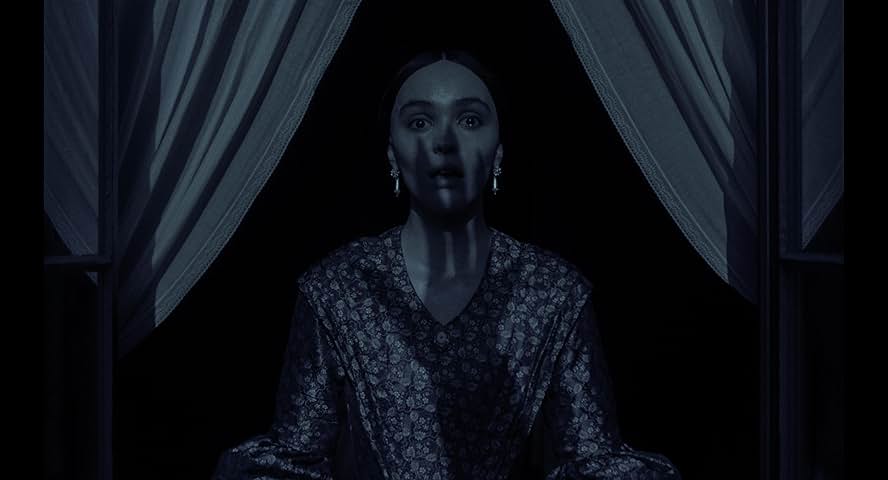
For me, two possible interpretations of the movie resonated with me the most. First is, as many others have also point out, the grooming and sexual assault subtext in Ellen and Orlak’s relationship. At the beginning of the film, we see a young Ellen – calling herself a child (which in language of the time could be a teenageror a sexually naive person, but), having a dollhouse in the background of her room. No matter her actual age, the symbolisms here clearly show her as a minor, and sexually naive.
But Ellen, contrary to what the women of her time are supposed to be, have an appetite for a companion. She called out to the angels and devils to bring her someone – anyone. And Orlok answered. This could be seen as an older predator taking advantage of a young child, grooming them, entering into a relationship with them, or sexually assaulting them. Ellen began accepting the vow to be with Orlok forever, to be his wife, and then started moaning. As it goes on, however – what was gentle became aggressive and painful (with a jumpscare of Orlok’s rotting corpse choking her). This is reminiscent of many female experiences; men who came to them as sweet and taking advantage of their naivety or desperation.
If one interpret this ‘union of flesh’ between Orlok and Ellen as an act of sexual assault – then it is so traumatising that it stays in her nightmare for years to come – which, again, is regrettably a common thing survivors have to endure.

The second interpretation of this story, for me, is mental illness. William Dafoe’s character noted that Ellen was a child born into the occult; it started young – as with mental illness. It separates you from the ‘normal’ people. And as you grow, this ‘Melancholia’ further inflicts upon you to the point that even those around you with the most intention will not understand you. The night terror possessions that Ellen had, her prophetic visions, and her disposition – is all dismissed by doctors and men of science as melancholy and hysteria, when in fact it was demonic possession. In real life, mental illness is similarly dismissed as overthinking or a simple change in mood or bad character – even by the men of science now. Orlok – this demon that haunts Ellen every moment since childhood, destroyed her family and friendship, and eventually ended her life – thus could be seen as a symbol for the toll mental illness take on the life of those who were merely born unlucky.
There is a line by William Dafoe’s character, Van Franz, that I found deeply resonating. After knowing she will have to die to save everyone – he said to Ellen that, in another life, she could have been a priestess. I cried at this line. In another life, perhaps this melancholia and sensitivity we have could be used for good – could be normal, could be celebrated, even. In another life, another time, being in-tune with your emotion and soft as a butterfly might have been valued. In another life, our most detested curse could be our most prized gift.
But not in this one. In this one, Ellen sacrificed herself by letting Orlok drinks her blood until dawn comes. It was the only way for him to be defeated; because of their intertwined nature it was destined that it must be her, and that she must die. This, unfortunately, is how many of us with mental illness sees it. Because of this affliction we have – there is only one escape from it. There Is only one way to kill the monster, and save everyone. In the real world, our sacrifice would save everyone from having to take care of us.
The best thing about the Gothic, contrary to all our attempts to fix interpretations onto the symbols of the story – is that all of it can be true at the same time; and that all interpretation being equally true is the point of the Gothic. By using the loose plot of this fable and endowing it with rich thematic elements – Egger has created a place, similar to the gothic literature of olds, for us to explore our darkest fears and fantasy and to take away from it whatever we want. Therefore, though the plot stays roughly the same as the 1922 film – this modern interpretation is something I would easily recommend to the modern audience. I think this film resonates heavily with many aspects of the human condition that are as true for the characters in historical Germany as for a student in Cambridge now. For the loose plot, character, logic, space and time – Egger made plenty of space for us to insert our own personal story and grapple with the shadow of this gothic land through our own interpretations.
Credits : Images from from IMDB
APPENDIX : CONTEXT Supplementing My Reading of Nosferatu (2024)
Now, with all the themes above, picture this little horror story.
You were a 19 years old who had very few friends her entire life. You were, more than words can describe, lonely. You long for the ‘best friend’ that everybody seems to have, but you struggle to connect to people at school and at university. They said your brain is wired differently, ASD. You have also been struggling with depression your whole life; also not great for making friends.
But recently, you have been making friends with older people; older men, to be exact. You were never really close to your father, no matter how hard you both tried. So, since childhood, you have had this hole in your heart. And you feel extremely guilty for it. Your father is a great father. So, why can’t you just be normal? Be satisfied? You were not. You sought out people who you wish could fill that hole in your heart.
And you found some. And for a while, even though you knew it was all wrong, you were happy. Even though you know this is not who your best friends should be, not where your utmost love should lie – you persist. In shame, but with justification; what other options do you have? You tried, so hard, to have a normal life; to befriend normal people your age. But when you had to call someone to talk you out of cutting your arms open on so many nights where the loneliness was too much – you didn’t have options. So, you persist with this ridiculous life; one that you know is unhealthy, that sucks away the personality you used to have, that renders you a child trying to please adults around you to earn their adoration.
Then, your depression came back. It was harder than ever. You crashed. And a friend left you for it. And that sent you to the lowest point you have ever been in your life.
And then you found another friend. Someone who came when you were at your worst. Who came gently; unassuming. A friend who made you feel wanted, who noticed when you are gone, who made you feel missed. Someone you admired; for their skills, intellects, appearances. Someone who gave you endless gifts and showered you with praise at everything you do; who complimented your every smile, every clothes, every word. Someone who would always make you the first priority, play with you all day, already plan a future with you in it without you having to constantly make plans to meet up.
Imagine you were so, so lonely; and you hate yourself enough you wanted to die. Hated the way you even talk and look. Hated everything about your skin and your soul. Believed that you were destined to be alone and that no one in the wide world could ever love you. And someone came along who treated you as the most beautiful, adorable, lovable being to him.
That your voice was something that swept away all his anxiety; that he needs to see your smile to do his work. He said he needs to talk to you each morning and night, wish you could be with him all day every day – and that without you, he is lost. Like Major Tom, he would say. He would say you were like his cat; make a nickname for you you are not allowed to tell anyone. Just between us. Do your parents look through your chat? He would use code words to say miss you when in public; if you actually say it in front of your parents he would freak out. You and him would go to have countless meals with your family though, of course. You would have countless meals with him too; his friends would all ask – is that your daughter? Who on earth is the mother? (laughter). He never brings his family, of course; he’s unmarried. But he wouldn’t even let you know where he lives. He lied about having siblings once. He seems to get jealous if you like other men better than him; but he would just pout like a child. You two would go to places alone, by his car (he doesn’t like that you two couldn’t have time alone with your driver there in your car). These road trips would go on almost everyday.
Because it is okay, right?
Even though you are smart. Even though you had your doubts. Even though he told you what to wear – that was just him seeing you like a dress-up doll; like fathers who like to dress up daughters. Even though he didn’t give you answers on why his messages to you have to be secret; he just is sensitive and shy with expressing his emotions. Even though he keep talking about how his favourite movies are the ones where the protagonists must overcome impossible odds to be together; that could be anything, you were just reading too much into it. Even when he ask you; who am I to you. You just answered: a friend.
You remember a time you were eating and you look up to ask him a question – and he was just staring at you, so lost that he had to take a moment to gather himself to answer your question. You knew that moment. You have seen it and read about it countless times in films and books. But that couldn’t be it. He introduced you to his friends jokingly as his daughter, after all. But you give it – the benefit of the doubt.
And when the neediness becomes too much; when you can’t call him everyday, meet him everyday, and when you don’t have enough energy to sustain the relationship anymore. You broke it to him; look, you have been a great friend – but you love me too much, I just can’t return the amount that you love me. You told him you couldn’t bear the intensity of this friendship anymore; that being so attached to him sucks all your time and energy and left you a husk of yourself. But it wasn’t his fault; he was just emotionally immature. You two were just incompatible friends. You gave him – the benefit of the doubt.
You have never been in a relationship or had a break up before – but you know enough psychology to see the similarity. You know enough to see the lovebomb. To see the grooming. To see that his love was more than platonic. And someday, you blame yourself; how could you have been so stupid as to ignore all the signs? Someday you even think; did you want to ignore all the signs. That you knew all along. That you are as disgusting as he is.
Your other friends understand that you are upset, but they also point out; you are 20 now. You are not a child anymore. Nothing wrong has been done. It would be better to minimize the whole thing and move on. And they are right – of course. But you just could not. Cats, Food, Music; all things you used to love now leave you the bitterest taste in your mouth. Your body is sent into panic when someone dressed similar to him is at the edge of your vision.
And his ghost doesn’t go away, not as easily as others make it so. You make new friends, but you will always, from now, be suspicious. From now, you will always have these thoughts at the back of your mind; who am I to them? Some day, you wonder, why that misconception and tension exist between you and people who are older than your father. What is so fundamentally wrong with you that you invite people you detested. You know what the people would say; that you want it, secretly. You know how they will never understand. And you are filled with hatred, and anger. At men, at the world – most of all, at yourself.
A 58 years old said he loved you romantically. A 58 years old did all this to a 19 years old autistic girl during the worst depression episode of her life. You were so desperate for a friend, so clouded by the heightened emotionality of depression, so fundamentally needing a father you could connect with. You saw yourself as a child who just needed a friend. But now, you began to question if you have been a misshapen, broken thing not fit for the normal social life all along. That this is the rest of your life
That was my first taste of adulthood. Picture that.
And now picture this, confused, little thing that is now set loose into the world; that is now fundamentally broken. Marked with the curse of experience that fundamentally altered your brain. And, on top of that, still cursed with an illness, a melancholy, that even those with the best intentions will never understand and end up dismissing. And if, one day, you find someone whose love was enough to turn you ‘normal’; to fulfill the hole in your heart you have had since birth, to completely understand and tend to your depression, to finally give you a chance to be in a normal relationship – to make you finally normal. Then, the only thing left on your mind – is the picture of them leaving. Of course, they must do – dead or alive; temporarily or permanently. They are, after all, not a cure. You, after all, are still broken. I see this picture of my life before my eyes every single day.
My psyche will never be cured. My melancholy will never be cured.
I wonder – will I succumb to the same fate as Ellen?
Will the darkness consume me and leave me a husk even amongst those who love me?
Will the end be the young maiden and death in an embrace – as it was destined to be?
I picture that, sometimes.
Leave a Reply